Loading global records…
January–August candidate releases · intervals through 10 September · provisional. Circle area represents event best estimates at source coordinates; location precision varies. Coded sides do not establish individual combatant status. Data ↓
RUSSIA–UKRAINE / THE HUMAN COST
No mark contains
the life it touches.
Three posters. Thousands of records. A way to bring the numbers within human reach.
Explore the three posters ↓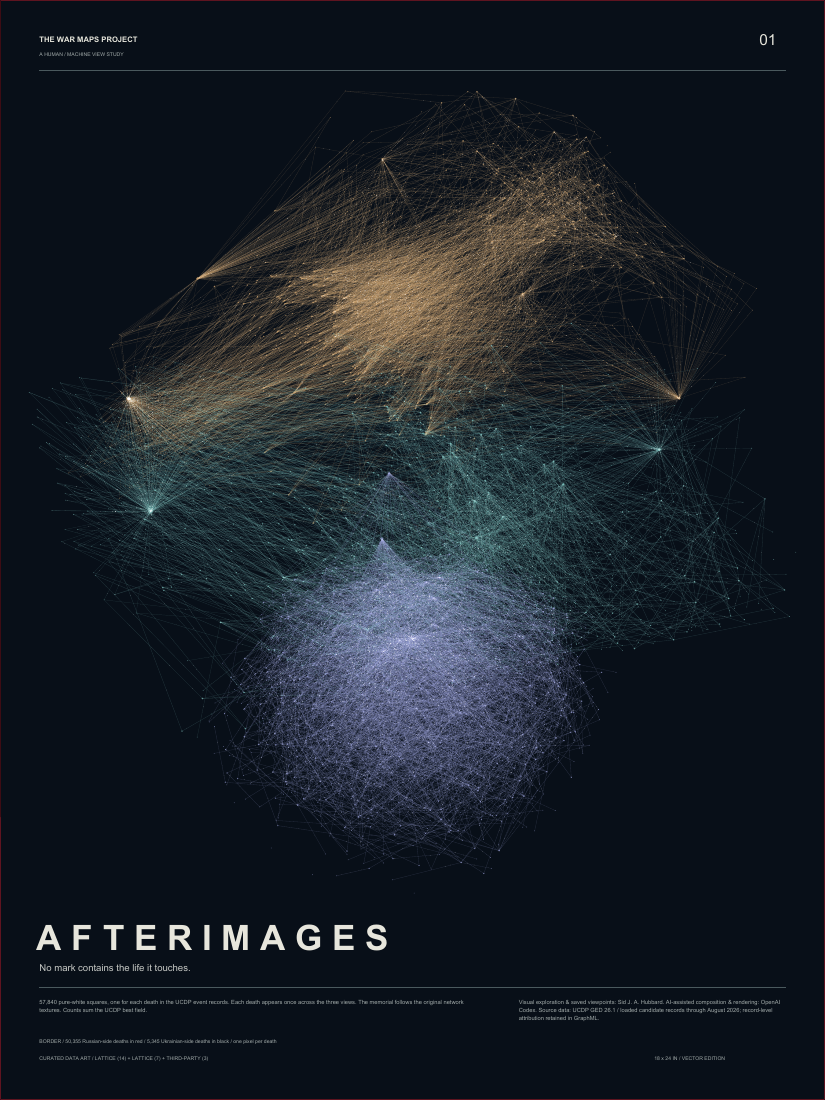
Each red pixel represents one Russian death.
01 / EVERY MARK COUNTS
Loading source boundaries…In the selected poster’s records.
The two coded sides occupy the circle. Civilian and unknown-status deaths sit below it, once each. Layout is symbolic; it does not locate people or events. Zoom in to resolve individual dots.
Loading the selected poster’s records…
02 / A SCALE YOU CAN HOLD
Think of a room
you know.
A classroom. A bus. A gathering of people whose faces you would recognize.
1,928groups of 30
An arithmetic comparison of the selected count to your group size. It does not estimate anyone’s personal risk or describe these people’s families.
03 / KEEP THE BOUNDARY IN VIEW
Same conflict. Different source windows.
These bars use the complete poster totals for your selected category. The 2026 source window is incomplete; a smaller bar does not establish a lower annual death rate.
The dot field uses the same dot spacing across all three years. Zoom and filters do not alter the source totals shown here.
04 / LOOK INSIDE THE NUMBER
Download year data ↓The records behind the field.
Dates and categories follow the controls above. Search narrows this register only.
05 / WHAT THE RECORD CAN SAY
Evidence stays attached.
Observation
These are sums of UCDP event-level best estimates, as selected for Sid J.A. Hubbard’s War Maps posters. A dot is a unit in an estimate, not an identified individual. Injuries and indirect losses outside the dataset’s scope are absent.
Enclosure
The enclosing field is the selected Russia–Ukraine conflict record. Inside it are coded sides, places, dated intervals and fatality estimates. The source releases, their coding rules and their coverage bound what this view can show.
Afterimages
Each red pixel in the artwork’s memorial border represents one Russian death. The original artwork keeps its colors and individual marks. The interactive poster fields use its gold, turquoise and lavender palette.
Transformation
Original circle coordinates are retained, normalized to one shared dot spacing and recolored with the gold, turquoise and lavender palette of Afterimages. Filtering changes the visible counts. Chronological playback uses interval end dates; positions remain symbolic.
What follows
Inspect the record before interpreting a change. Compare like source windows. Preserve missing information rather than assigning it to a side. A pattern in this display alone does not establish a cause, a legal finding or a personal risk.
Sources & credits
- The selected poster collection ↗
- War Maps: source, code & methods ↗
- UCDP GED 26.1 codebook ↗
- Candidate events codebook ↗
- Provenance ↓
UCDP data: CC BY 4.0; Sundberg & Melander (2013). Research, visual direction and publication decisions: Sid J.A. Hubbard. Composition and engineering: AI-assisted with OpenAI Codex.
No analytics. No location request. Group size stays in this page and is not transmitted.
2024 and 2025: reviewed GED 26.1, full calendar years. 2026: selected January–August candidate releases; some recorded intervals reach 1 September. Candidate estimates remain provisional and distinct IDs may still contain overlapping reports. These sums are not a census of unique people.